Friday, May 7, 2010

Pet Food Day

Today I made the montly pet food for our 2 cats and 1 Papillon dog.  I don't really have a huge knowledge base for cat and dog nutrition so until I know more, I supplement with dry food (in case I'm off base) but I also don't want them eating too much processed foods considering all the pet food recalls. I also had a cat die, I think from complications due to soley eating processed pet food.  (scary stuff)

Pet food recipe for Cats/kittens/dogs:


Keep in mind that I am not totally knowledgeable about this…you need to do your own research on nutritional needs of your pets..When you do this, please keep me up to date too---because I am still gathering info, myself..


Kittens need more fat and protein and fish oil..(from what I’ve read/heard)

I add some garlic, because I’ve heard that it can control fleas… however, garlic can also cause anemia..my cat’s blood was tested recently, however and she was fine.. I have to weigh the choice of “garlic toxicity” vs. “pesticicide toxicity” the garlic truly has kept the fleas away. They went off of the garlic for 2 months because I was worried after reading about the anemia…and all of our pets got fleas..(and they had never gotten fleas before…) I am back to using garlic…Onion is also supposed to be bad for pets. I don’t use onion..but I use a small amount of the garlic. So use garlic at your own risk..Time will tell on this one, I think… (I have also read some "officially published pet recipes that include garlic...so there is mixed info out there)


For cats/kittens: (this amount usually takes a month to use up for 2 cats)

I use a food processor to make this quicker/easier, but you don’t have to…

1. Boil one large chicken in a stock pot until mostly cooked. Take out of the water (make sure no bones are left in stock) and let cool. Keep stock.


(and also cook some organ meat: chicken,lamb liver, heart, etc..(you have to be careful not to add too much organ meat; I read too much can cause problems as well)
  • also for cats you can add/cook 1-2lbs whitefish


2. In a food processor chop up:

1 carrot

½ bunch of kale

1 sweet potato

1 apple
1 egg

1-2 cloves of garlic


It is nice to have a little helper who likes to press the on on the food processor and mix things up.


3. Add to the stock along with:

¼ cup each of these grains: quinoa, pearl barley, oats/groats

I add grains…but I try to keep the grain ratio lower. Perhaps I shouldn’t add grains at all…I’m unsure of this.. but it soaks up the stock and makes it seem more like the canned cat food and adds nutrients.. (but don’t know the facts of the bioavaiability, etc.) In any case, it seems better than processed foods that have tons of grains, etc.. ?? this part needs more research on my part..


4. cook together…and chop up the chicken by hand/debone, etc..

5. add chicken and veggies, 1/2 cup of brewers yeast (also good for controlling fleas).

6. Fill jars that are appropriate size to be eaten by your pet within 3-5 days. I use a quart size because I have 2 cats. For one cat: probably use a pint size. Leave some good head room at top of jar for freezing expansion.

7. wash off the jars and refrigerate overnight before putting in freezer.  Imorportant to refrigerate before putting in freezer because jars could crack.  Make sure to leave adequate head room at top of jars because the contents expand.

8. I feed my cats a tablespoon or two or so twice a day in additon to leaving out hard food.


For Dogs: (I have a small Papillion dog) and this quantity last a month for this dog.

· The recipe is the same except:

For quantities of grain. And I don’t add fish:


· 1 bunch of kale

· and 1 full cup each of the grains.

Today, it took me about 3 hours to make it and get in the refrigerator.  (but that does not include clean-up. (-;  The dishes are still in the sink... 


I think you could also use a much simpler recipe…by simply feeding the pets the chicken/fish/organs on a regular basis….I also want to learn more about the raw food diet for pets.. I feed them hard food still so help with tarter..and because I can’t make the wet food more than 1x/month due to how long it takes and all the prep, etc..

Both the cats and dog really enjoy their food...Happy Pets.

(just kidding)


If you have any info on pet nutrition, please comment.  This recipe seems to change everytime I make it...it is an "organically changing recipe" because I'm still learning..  and I'd love to hear if anyone else out there is making pet food

Tuesday, May 4, 2010

Peanut Butter

Ok, I have discovered that making peanut butter is super super easy. And if you are like me, you want the better kind of peanut butter--Maranatha costs $$$  for a jar.  $7 or so, I think..  This PB is just as good if not better and much much cheaper.. I pay $11.90 for 5 pounds of  organic peanuts from Azure Standard.  To make about 1 quart, I think I used about 1 pound of peanuts...so my jar of peanuts cost me $2.50  and it was organic and of premium quality with no additives or preservatives, etc.. (not to mention easy!)

  1. scoop up few couple cups of peanuts.
  2. place in food processor
  3. add salt if you wish
  4. let it chop for quite awhile (sometimes you may need to stop it and scrape under the blade) until it is creamy
  5. put in jar and enjoy!!!  (repeat depending on capacity of food processor and how much you want to make)

Monday, April 26, 2010

Asparagus and Pizza!


Crust
3 cups of flour (sometimes I mix whole wheat and some white together-I do it differently each time)
2 TB oil
2TB sugar
1tsp salt
1 TB dry active yeast
1 1/4-- 1 1/3 cups warm water (it depends on how soft you want your crust)

Add warm water to dry ingredients, then add oil.  mix  and work the dough with mixer or by hand until it is stretchy and a bit sticky.  cover bowl with a plate and let sit on counter to rise for an hour.  Then roll onto baking pan/pizza stone (whatever you have on hand)  Bake at 350 for 15 minutes.  Put aside.


Sauce
1 can of tomato sauce ( or your own canned tomato sauce)  
1 small can of tomato paste
garlic salt (or real garlic)
basil and/ or your spices of choice 
warm up and simmer so the flavor is cooked into it.

Toppings
Mozzerella cheese or a mix of cheeses
I like to use seasonal vegetables.  Right now asparagus is in season.  Zucinni and eggplant are wonderful on pizza, in my opinion.  My kids really like pepperoni.  Garlic is also WONDERFUL on pizza too..  Basically whatever you like...  When fresh basil is in season, I put tons of it..  or spinnach.. Pizza can be very creative and can be done "on a budget"  and "in season"

Bake your pizza at 350 for 15 minutes. 

Sunday, April 25, 2010

Feeling Soo inspired by book Radical Homemaking

Reading this book and feeling sooooo inspired. This is beyond liberal/conservative--It is NOT about being "subservient" or "less than"--It is about being independent of corporations--of developing SKILLS that have been lost..so that we don't have to be in such a hurry and have to buy (McDonalds or other convieniences)--so we can eat healthy food...and buy less "stuff" and instead spend time together as familiies and community..get to know our neighbors.. And also feel fulfilled/self-actualized---and be responsible to our planet, our animals, and people in 3rd world who sweat blood/starve to make our $5 t-shirts.


page 54

The first sacrice we make to this extractive economy is our time...we attribute little or no value to our time, unless it is used in a process whereby money changes hands..It matters not what the time was used for, so l ong as the trade resulted in the generation of dollars. "It could go to thinking up new ways to seduce children into drinking more cola, or plotting ways to subvert clean air laws," notes Rowe. "So long as the time has flowed into the market and increased the churn of money there, it has been used beneficially where the economic mind is concerned. " Once we have sacrificed our time to the extractive econonmy, there is even more money to be made, because we now must use our hard-earned cash in order to purchase substitues for the time we've traded. We buy take-out and fast food when we don't have time to cook dinner. We buy prescription drugs when we no longer have time to take care of our health and get ample rest. We buy luxury goods for our loved ones as a substitute for spending time together. We throw out our shoes when the soles wear thin, toss our electronics into landfills when they stop working properly, because it takes too much time to repair them. In the long run, we wind up cash-poor and time-destitute, while coporate American
accumulates our wealth."


Page 58 Toward a Life-Serving Econonmy

(Shannon Hayes says that whether we work in the home or outside the home, it is important we follow these 4 tenets in our livelihood)
1.  Respect and care for the community life.
2. Ecological integrity
3. Social and economic justice
4. Democracy, nonviolence and peac

Sunday, March 28, 2010

4th Season of Gardening. Starts with a simple seed.


Three Years Ago in April we bought our home and moved in.  Before we were even fully unpacked, I bought some starter pots and seeds and started my first tomatoes since I was a child.  One of the most exciting aspects to owning our own house (for me) was the chance to start a garden.  When I was a child my parents had a large garden during the summer and we grew lots of fresh veggies and I learned how to start seeds, compost, plant, and weed from them.  Tomato plants give off a very unique scent, that always gives me a wonderful feeling of nostalgia. 
The first year, we measured out an open space between our shed and the fence and copied a friends' design. We bought some pressure treated wood from Home Depot, (about 10'x 10')
 drilled screws in, and stapled strong black plastic around it. (because pressure treated wood has tons of toxins/chemicals in it).  We filled it with bags and bags of soil and compost, and added stones for the kids to walk on. (BTW: This was not the cheapest way to make a garden)  But, it wasn't too hard and we had a beautiful first garden that grew a surprising amount of food in about 100sqft.


The second year, we inherited some old wood and we decided to make two more beds about 5'10' each.  We used brackets to hold the lengths together, and screwed the sides together.  We ordered a truckload of soil-manure/compost mix and worked it into the orignial soil under the beds.  This was a much cheaper alternative to making beds..finding used lumber and making what you can from it.

The older bed from the previous year became a permanent/perennial garden where I bought some strawberry and asparagus crowns.  These crops will produce year after year without much more work than weeding and fertilizing.  Asparagus takes 3 years for a good crop, so you have to be patient for it to reach maturity, but it will reward you with a nice early spring crop of asparagus (march-april) every year for twenty years afterwards.  I also, as you may see to the right of the bed, bought some blueberry and raspberry bushes.


Year Number Three, I started to read a lot about gardening, about building the soil, making beds, companion growing.  And from this reading, I recommend several really good books.


There are many more books out there, but these books give a good beginner's guide to making boxes and growing food. 

The third year, we expanded some more by making two more boxes in the front yard; the best place for full sun. I was finding that my tomato plants weren't quite getting enough full sun in the backyard, and I wanted to try growing corn which also needed more sun.  Our next two beds, we wanted to "look nice" because of being in the front yard. This time, we went non-toxic and invested in cedar(cedar is expensive though, but will last a long time). 2 beds 5x10. Two boards stacked, screwed into a middle thicker block in each corner.  I was also reading about the advantage of growing vertically.  Many vining foods such as peas, beans, cucumbers, pumpkins, squashes, even tomatoes can grow up a vertical frame.   We created 4 vertical frames and nets to place on 2 of the new beds and the other 2 beds from the previous year.  (this next picture I took today of this bed March 09) The one after it is from last year's peak harvest in August. 09.  These frames are 5'-6' tall and 10' across with pea netting.  I layed newpaper (used lasagna method) over the grass and wet down, covered with leaves, compost, left-over soil from our french drain project, and bought some manure, vermiculate, peat moss, and some extra growing soil.  (building a good soil is very important because you want your veggies to have good nutrients in them)--bad, depleted soil=weak, not nutritious veggies


This next picture is of the other 2 beds with vertical frames.
And here is the 1st year bed with aspargus fronds. You just let them grow and not cut them down until they turn brown in the fall. Then you cover them up with straw.

And strawberries
And raspberries/blueberries

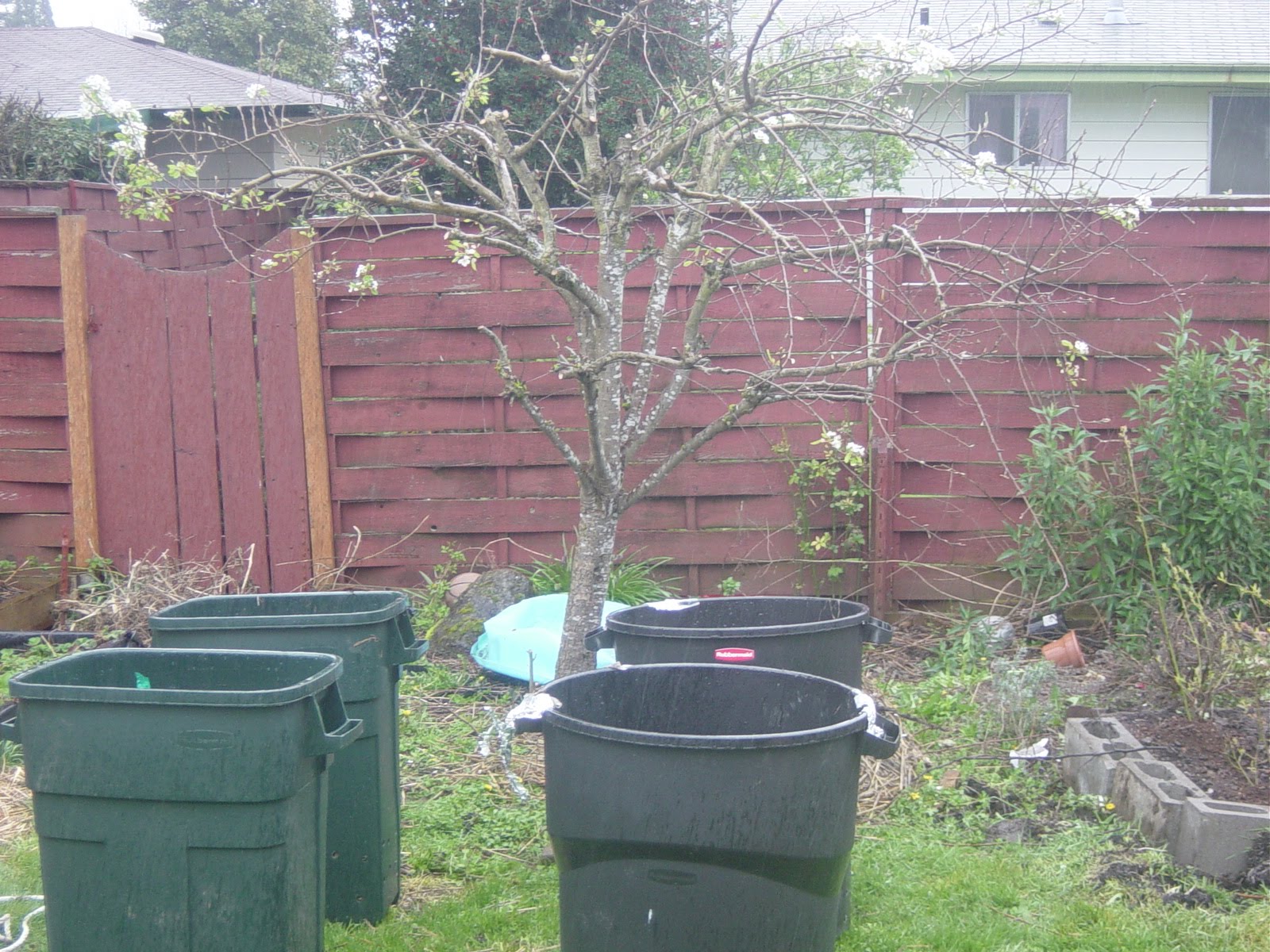
Last year, we also grew potatoes in garbage cans.  I bought 4 garbage cans, drilled holes in the bottom and 1/3 up the sides for drainage. Put some pea gravel in the bottom of them. (potatoes really need to have soil that drains) and put potting soil and compost 1/4 of the way up, planted the seed potatoes 4-5 per can) covered with more compst and soil. (this year, I'm economizing and bulking it with straw) I covered the sides with tin foil  to reflect light. They need lots of sun.  As the leaves grow up, keep covering the stems with more soil. Always keep those stems covered.  They will eventually flower.   I think they are done when they wither.  That is about when I harvested them last year. Just dump the soil out.  Don't reuse the soil for potatoes again for 3 years, but the soil can be used for other things. 

Below is the 4 garbage cans for potatoes and our pear tree behind them.

These past 3 Seasons, we have also composted our vegetable scraps, which in itself deserves its own blog entry as does growing each vegetable/fruit, but this entry is a survey of what we have done, and perhaps I'll go into more detail later.  We use 2 earth machines. 


And some smaller projects are an herb garden, rhubarb, fruit trees, and recently we moved the blueberries. (don't plant near raspberries--raspberries will bury them!!) Another hint about blueberries (they like peat moss/acid soil)  I made this bed very economically out of cinder blocks we already had and the left-over soil from last years' potatoes.  Behind them is a little rosemary. (sooo good on chicken and lamb!)


turned the flower box into an herb garden

rhubarb and flowers
cherry and apple trees

We also have  mature pear and apricot trees, and another baby apple tree.  There is so much you can do to a small-medium city lot (especially with the square foot gardening idea and growing vertically) and adding some perennials like strawberries, fruit trees, asparagus, rhubarb, etc..!

Caring for your garden:  During the summer, around here, it gets really dry, so I water them every day.  Some people invest in a drip method. I haven't researched this yet..perhaps I'll do that too at some point. For now, I have hoses hooked up to sprinklers, because I can't hand water it all every day with over 300 sq. ft in different parts of the yard...so I let the hoses and sprinklers do it for me.  Another idea, we may try, though is to invest in rain barrels to collect water hooked up to our downspouts...This will be more laborous, but much more "sustainable" in conserving water. 

Each year, I also build up the soil, add manure and compost.  Plants really need nitrogen.  There is so much to share and to learn...and many details add.  This really only scratches the surface.  I really recommend reading and finding a way that works best for you.  We've tried different ways, by making the different types of beds, but recently I'm intrigued by how resourceful my next door neighbor is at finding material that does not cost too much, such as the cinderblocks and bricks, and scrapwood and her garden is absolutely gorgeous!  She is very good at composting too.  My compost is taking a long time to "cook"--I don't turn it often enough, not do I cut up the scraps small enough, etc.. 

In any case, I hope this is helpful to you starting out.  I hope you get a sense that we started small and just added on each year...Even the smallest space can produce a great amount of food. 

Some more books I recommend (on gardening and food) 


Saturday, March 13, 2010

SOAPMAKING: Making Tallow, Coconut oil, Olive oil soap

Not long ago, we took the plunge and made soap!

Rendering Suet into Tallow
1. The first thing we did was to render the tallow, which means taking a chunk of suet, chop it up into small pieces, immerse it in water in a stock pot and boil it until it melts and looks like this. We had 3 big blocks of beef and lamb suet in our freezer, and we made about 14 pounds of soap.


2. Then we strained out the chunks of meat and gristle using a very fine collander.  taking it one measuring cup at a time, and let cool, then placed in refrigerator overnight until the fat rose to the top of the water and could be removed, cut.


3. Then I froze the tallow until ready to use to make the soap.


Making Basic Soap:


Basic soap Recipe:
40 oz tallow
20 oz olive oil
20 oz coconut oil
11.3 oz sodium hydroxide (lye) (5% superfatted) lye calculator
30 oz distilled water


Precautions:
  1. Always add lye gradually to water, not the other way, because it could react too fast.
  2. Use gloves, goggles (you never want to touch the lye or get any in your eyes)
  3. Have vinegar on hand to neutralize the lye. You can make a solution of soap, water, vinegar to neutralize it immediately if it gets on your skin or counter, etc.
  4. Never use alluminum w/lye. Use stainless steel, wood, or strong plastic.
  5. open a window near where you will be working. There is some offgassing from the chemical reaction.
Essential tools: (basic soap)
Brambleberry Soap supplies
  1. stainless steel pots
  2. wood or silicone stirrers.  (wood will wear -out faster)
  3. Immersion blender w/stainless stell blade. (this is not absolutely necessary, but it will help the process take much less time)
  4. large plastic tupperware container  or wooden mold.
  5. Large cutting knife, or soap cutter.
  6. 2 candy thermometers
  7. 2 dishpans for cold water baths
  8. 1 pitcher (2L) (strong plastic or stainless) with spout (for water that will be mixed with lye
  9. 1 pyrex 2cup measuring cup.  (for dry lye) with spout.
  10. goggles
  11. gloves
  12. mask
  13. dishpans to put lye covered dirty dishes in to rest for 24 hours before washing.
  14. (optional) newspaper to cover areas you don't want lye to touch
  15. 1 kitchen scale
  16. plastic canvas/needlework canvas for curing soap
Tools for Milling
  1. soap molds
  2. colors
  3. distilled water
  4. fragrances
  5. herbs, wheat germ, oatmeal, etc..(whatever additives the recipe calls for)
  6. food processor makes grating basic soap easy
  7. double boiler or insert to make 2 pans turn into double boilerdouble boiler maker
  8. olive oil spray

Process
  1. measure out your fats, add them to a pan, and melt.  (add candy thermometer 1).  Turn off stove when it is all melted.
  2. measure your water and lye, then add your lye to your water and mix until it is dissolved. (add candy thermometer 2)
  3. You want the 2 mixtures: fat and lye water to register the same temp about 100-105 degrees F. You can lower temp by putting container in cool water bath. It helps to have 2 people to do this. 
  4. When they are the same temp, very slowly add the lye water to the fat..like a very thin string-like stream and mix with spoon.
  5. After it is mixed in, take the immersion blender(ALWAYS keep blender blade UNDER the liquid-you don't want any lye spraying out at you!!) and blend for about 10 minutes or until it reaches "trace" (when it slightly thickens and will hesitate to drip off the blender/spoon) or leave a mark on the top that stays only for a moment when stirring with spoon)
  6. After trace, you can either add your addtives oils, etc.. (recipe) or simply pour into mold.  I recommend milling rather than putting additives in at this point. The recipe is still reacting and may compromise the oils, or freeze up and you risk spoiling the batch. Milling is more work, but more guarenteed to accomplish the kind of soap you may want.
  7. Cover the mold, then wrap 2 towels around it to keep it warm for about 48 hours while it finishes reacting and sets.
  8. After it sets, unmold it onto a cutting board. Still wear gloves, because there could potentially be lye pockets in the soap.  cut up the soap into bars.
  9. At this stage, you can either cure the basic soap. (it needs to dry for 3-4 weeks) or you can mill it into more specialized soaps.  If you cure it at this step, lay it out onto plastic canvases, flip every once in a while and let dry.
Milling soap
I recommend the recipes in this book:


just watch out in some versions, there is a mistake in it where it says to add water to the lye..those books were recalled, but I ended up with one of those, so they are in circulation. 


  1. Essentially, you take a pound of your soap, you grate it (a food processor makes this much easier).

  2. You measure about 9 oz of water. 

  3. You slowly melt your soap into the water (adding water gradually to melting soap (using double boiler). Sometimes this can take up to an hour.  Depending on your type of soap.  With my recipe, it did take about an hour. 

  4. After it is melted, you can mix in your addtives.

  5.  spray your molds(very lightly) with olive oil spray, then put soap into molds,

  6. put molds into the freezer for 1-2 hours,

  7. then unmold onto the canvases to cure for 3-4 weeks. They will shrink. 

  8. Then shave off edges

  9. package.  I used sheer pourous fabric to wrap in then I tied them and included a tag(with ingredients) that was attached to the string.

For Kids
  • There is a VERY easy way to make soap with children.  You buy a base melt and pour soap, you melt it in a double boiler and add color/fragrance and pour into molds. let sit until it hardens, then unmold and it can be used immediately.  

Wednesday, March 10, 2010

Fasting, Addiction, Filters, and Dinosaurs-Oh MY!

Baha'i Faith on Fasting


Prayer and fasting is the cause of awakening and mindfulness and conducive to protection and preservation from tests.~ ‘Abdu’l-Bahá

I have really wanted to blog about the soapmaking adventure for quite awhile, but my time been extremely "filled up" with making the soap, Ayyam-i-Ha, my husbands and daughters' birthdays and now the Fast.  I am really struggling with fasting today.  I am craving spaghetti and it would be sooo easy to make it right now.  Both kids are at school. I'm home alone for just long enough to make it and enjoy it..  I decided that the best thing to do would be to blog about some of the topics, I've been wanting to for awhile with the time instead.  I have a headache today, because I drank coffee this morning.  (something that is NOT a good idea while fasting for 12 hours) 

Addiciton is a hard thing to deal with.  Addiction to foods, to escapisms, to "things"...wanting to buy things.. (even buying sustainable things (or cooking things, or soapmaking things) can be very addicting). 

I am really hoping that fasting will help this everyday struggle to keep filtering...to be a better filter.

My family and I went to see "Walking with Dinosaurs" with the kids a couple of weeks ago. http://www.dinosaurlive.com/  It was very expensive, but we rationalized that we won't be going to Disney World anytime soon..And we vowed we wouldn't buy ANYTHING there.  Deciding that is one thing, but it becomes harder when faced with "Pressure"...We managed to walk by all the snack and souvenir stands with people actually approaching us to "buy"..We sat down in our seats, thinking "Phew" we got through that and the kids did  not tantrum about not getting anything.

But before the show started, they entered the seating area shouting, "ice cream, popcorn, cotten candy"...It was ridiculous...and it wasn't only once they did this.  They did it at least twice or three times...Before the show and during intermission.  We managed to live up to our goal and did not buy any of it, but our kids felt "deprived"...They were very disappointed..  And we were angry for the constant pressure..

I resent this pressure. It is hard enough to resist it, without always being pressured and manipulated...linking sense of self worth with material possessions...is often the strategy....Filter. Filter. Filter

Sometimes, I "pass this test"...Sometimes I don't..

My Fasting thoughts:
I notice that for me, each day has a unique challenge. for example: One day it was the physical discomfort of being hungry/thirsty, another day was emotionally wanting the habit foods/snacks/coffee. and another day being bored/grumpy with it-wanting it done. another day-feeling really spacey and tir...ed. Each day is unique...like a test a day to try to pass. 

Lately, it hasn't been "fun"...In the past, I felt good about fasting..The challenge of it, made it rewarding.  This year is difficult, because I don't "feel" the reward.  Perhaps that is an addiction too..I read that part of the resistance that kids have to "practice" an instrument is that it is not always fun or rewarding for them.  It is part of growing up; being able to do something even if you don't feel the reward.  (this depresses me, because I don't think I'm even there yet.)  Does that mean I'm not as mature as I'd like to be...I suppose I still have some "growing up" still yet to do.  Fasting is NOT fun for me today.  So, far, I'm doing it, though.  But, I'm depressed about it.  I don't feel "good" about where I'm at yet.  I make one step forward and 2 steps back sometimes.  Trying to be sustainably minded, spiritually-minded...  But, I'm not quite "grown-up" yet.  I still want a reward and feel depressed about having to "let go" of that..  I do not always "deserve" or I am not always "entitled" a reward even if I've had a hard day, or "the hardest day"...

But on a more uplifiting note:

Here is what Rumi says about fasting:

There's hidden sweetness in the stomach's emptiness.
We are lutes, no more, no less. If the soundbox is stuffed full of anything, no music.
If the brain and the belly are burning clean with fasting, every moment a new song comes out of the fire.
The fog clears, and new energy makes yo......u run up the steps in front of you.Be emptier and cry like reed instruments cry.Emptier, write secrets with the reed pen.When you're full of food and drink, an ugly metal statue sits where your spirit should. When you fast, good habits gather like friends who want to help.Fasting is Solomon's ring. Don't give it to some illusion and lose your power, but even if you have, if you've lost all will and control, they come back when you fast, like soldiers appearing out of the ground, pennants flying above them.A table descends to your tents,Jesus' table.Expect to see it, when you fast, this table spread with other food, better than the broth of cabbages. from The Illuminated Rumi, Translated by Coleman Barks