Sunday, March 28, 2010

4th Season of Gardening. Starts with a simple seed.


Three Years Ago in April we bought our home and moved in.  Before we were even fully unpacked, I bought some starter pots and seeds and started my first tomatoes since I was a child.  One of the most exciting aspects to owning our own house (for me) was the chance to start a garden.  When I was a child my parents had a large garden during the summer and we grew lots of fresh veggies and I learned how to start seeds, compost, plant, and weed from them.  Tomato plants give off a very unique scent, that always gives me a wonderful feeling of nostalgia. 
The first year, we measured out an open space between our shed and the fence and copied a friends' design. We bought some pressure treated wood from Home Depot, (about 10'x 10')
 drilled screws in, and stapled strong black plastic around it. (because pressure treated wood has tons of toxins/chemicals in it).  We filled it with bags and bags of soil and compost, and added stones for the kids to walk on. (BTW: This was not the cheapest way to make a garden)  But, it wasn't too hard and we had a beautiful first garden that grew a surprising amount of food in about 100sqft.


The second year, we inherited some old wood and we decided to make two more beds about 5'10' each.  We used brackets to hold the lengths together, and screwed the sides together.  We ordered a truckload of soil-manure/compost mix and worked it into the orignial soil under the beds.  This was a much cheaper alternative to making beds..finding used lumber and making what you can from it.

The older bed from the previous year became a permanent/perennial garden where I bought some strawberry and asparagus crowns.  These crops will produce year after year without much more work than weeding and fertilizing.  Asparagus takes 3 years for a good crop, so you have to be patient for it to reach maturity, but it will reward you with a nice early spring crop of asparagus (march-april) every year for twenty years afterwards.  I also, as you may see to the right of the bed, bought some blueberry and raspberry bushes.


Year Number Three, I started to read a lot about gardening, about building the soil, making beds, companion growing.  And from this reading, I recommend several really good books.


There are many more books out there, but these books give a good beginner's guide to making boxes and growing food. 

The third year, we expanded some more by making two more boxes in the front yard; the best place for full sun. I was finding that my tomato plants weren't quite getting enough full sun in the backyard, and I wanted to try growing corn which also needed more sun.  Our next two beds, we wanted to "look nice" because of being in the front yard. This time, we went non-toxic and invested in cedar(cedar is expensive though, but will last a long time). 2 beds 5x10. Two boards stacked, screwed into a middle thicker block in each corner.  I was also reading about the advantage of growing vertically.  Many vining foods such as peas, beans, cucumbers, pumpkins, squashes, even tomatoes can grow up a vertical frame.   We created 4 vertical frames and nets to place on 2 of the new beds and the other 2 beds from the previous year.  (this next picture I took today of this bed March 09) The one after it is from last year's peak harvest in August. 09.  These frames are 5'-6' tall and 10' across with pea netting.  I layed newpaper (used lasagna method) over the grass and wet down, covered with leaves, compost, left-over soil from our french drain project, and bought some manure, vermiculate, peat moss, and some extra growing soil.  (building a good soil is very important because you want your veggies to have good nutrients in them)--bad, depleted soil=weak, not nutritious veggies


This next picture is of the other 2 beds with vertical frames.
And here is the 1st year bed with aspargus fronds. You just let them grow and not cut them down until they turn brown in the fall. Then you cover them up with straw.

And strawberries
And raspberries/blueberries

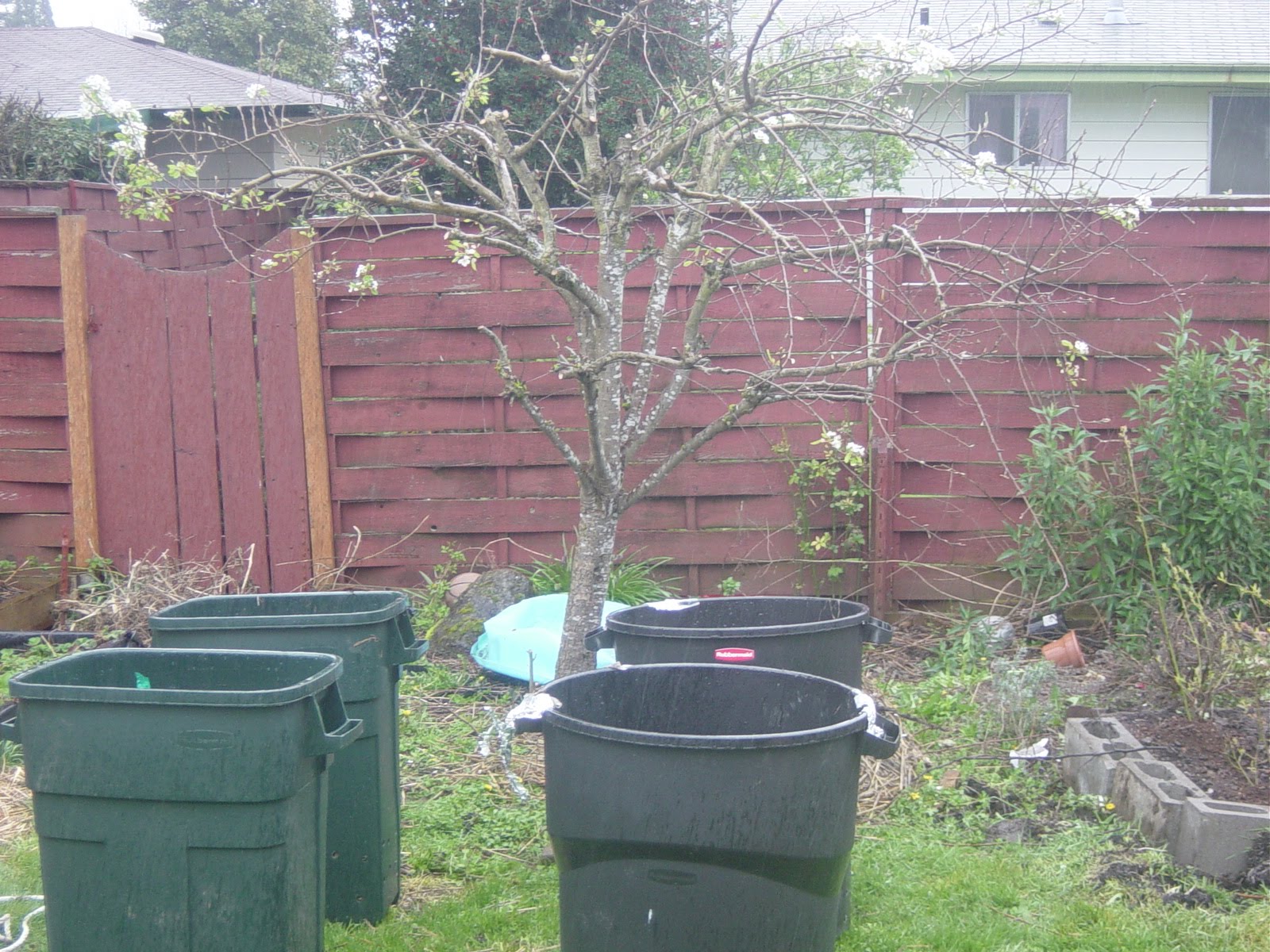
Last year, we also grew potatoes in garbage cans.  I bought 4 garbage cans, drilled holes in the bottom and 1/3 up the sides for drainage. Put some pea gravel in the bottom of them. (potatoes really need to have soil that drains) and put potting soil and compost 1/4 of the way up, planted the seed potatoes 4-5 per can) covered with more compst and soil. (this year, I'm economizing and bulking it with straw) I covered the sides with tin foil  to reflect light. They need lots of sun.  As the leaves grow up, keep covering the stems with more soil. Always keep those stems covered.  They will eventually flower.   I think they are done when they wither.  That is about when I harvested them last year. Just dump the soil out.  Don't reuse the soil for potatoes again for 3 years, but the soil can be used for other things. 

Below is the 4 garbage cans for potatoes and our pear tree behind them.
These past 3 Seasons, we have also composted our vegetable scraps, which in itself deserves its own blog entry as does growing each vegetable/fruit, but this entry is a survey of what we have done, and perhaps I'll go into more detail later.  We use 2 earth machines. 


And some smaller projects are an herb garden, rhubarb, fruit trees, and recently we moved the blueberries. (don't plant near raspberries--raspberries will bury them!!) Another hint about blueberries (they like peat moss/acid soil)  I made this bed very economically out of cinder blocks we already had and the left-over soil from last years' potatoes.  Behind them is a little rosemary. (sooo good on chicken and lamb!)


turned the flower box into an herb garden

rhubarb and flowers
cherry and apple trees

We also have  mature pear and apricot trees, and another baby apple tree.  There is so much you can do to a small-medium city lot (especially with the square foot gardening idea and growing vertically) and adding some perennials like strawberries, fruit trees, asparagus, rhubarb, etc..!

Caring for your garden:  During the summer, around here, it gets really dry, so I water them every day.  Some people invest in a drip method. I haven't researched this yet..perhaps I'll do that too at some point. For now, I have hoses hooked up to sprinklers, because I can't hand water it all every day with over 300 sq. ft in different parts of the yard...so I let the hoses and sprinklers do it for me.  Another idea, we may try, though is to invest in rain barrels to collect water hooked up to our downspouts...This will be more laborous, but much more "sustainable" in conserving water. 

Each year, I also build up the soil, add manure and compost.  Plants really need nitrogen.  There is so much to share and to learn...and many details add.  This really only scratches the surface.  I really recommend reading and finding a way that works best for you.  We've tried different ways, by making the different types of beds, but recently I'm intrigued by how resourceful my next door neighbor is at finding material that does not cost too much, such as the cinderblocks and bricks, and scrapwood and her garden is absolutely gorgeous!  She is very good at composting too.  My compost is taking a long time to "cook"--I don't turn it often enough, not do I cut up the scraps small enough, etc.. 

In any case, I hope this is helpful to you starting out.  I hope you get a sense that we started small and just added on each year...Even the smallest space can produce a great amount of food. 

Some more books I recommend (on gardening and food) 


Saturday, March 13, 2010

SOAPMAKING: Making Tallow, Coconut oil, Olive oil soap

Not long ago, we took the plunge and made soap!

Rendering Suet into Tallow
1. The first thing we did was to render the tallow, which means taking a chunk of suet, chop it up into small pieces, immerse it in water in a stock pot and boil it until it melts and looks like this. We had 3 big blocks of beef and lamb suet in our freezer, and we made about 14 pounds of soap.


2. Then we strained out the chunks of meat and gristle using a very fine collander.  taking it one measuring cup at a time, and let cool, then placed in refrigerator overnight until the fat rose to the top of the water and could be removed, cut.


3. Then I froze the tallow until ready to use to make the soap.


Making Basic Soap:


Basic soap Recipe:
40 oz tallow
20 oz olive oil
20 oz coconut oil
11.3 oz sodium hydroxide (lye) (5% superfatted) lye calculator
30 oz distilled water


Precautions:
  1. Always add lye gradually to water, not the other way, because it could react too fast.
  2. Use gloves, goggles (you never want to touch the lye or get any in your eyes)
  3. Have vinegar on hand to neutralize the lye. You can make a solution of soap, water, vinegar to neutralize it immediately if it gets on your skin or counter, etc.
  4. Never use alluminum w/lye. Use stainless steel, wood, or strong plastic.
  5. open a window near where you will be working. There is some offgassing from the chemical reaction.
Essential tools: (basic soap)
Brambleberry Soap supplies
  1. stainless steel pots
  2. wood or silicone stirrers.  (wood will wear -out faster)
  3. Immersion blender w/stainless stell blade. (this is not absolutely necessary, but it will help the process take much less time)
  4. large plastic tupperware container  or wooden mold.
  5. Large cutting knife, or soap cutter.
  6. 2 candy thermometers
  7. 2 dishpans for cold water baths
  8. 1 pitcher (2L) (strong plastic or stainless) with spout (for water that will be mixed with lye
  9. 1 pyrex 2cup measuring cup.  (for dry lye) with spout.
  10. goggles
  11. gloves
  12. mask
  13. dishpans to put lye covered dirty dishes in to rest for 24 hours before washing.
  14. (optional) newspaper to cover areas you don't want lye to touch
  15. 1 kitchen scale
  16. plastic canvas/needlework canvas for curing soap
Tools for Milling
  1. soap molds
  2. colors
  3. distilled water
  4. fragrances
  5. herbs, wheat germ, oatmeal, etc..(whatever additives the recipe calls for)
  6. food processor makes grating basic soap easy
  7. double boiler or insert to make 2 pans turn into double boilerdouble boiler maker
  8. olive oil spray

Process
  1. measure out your fats, add them to a pan, and melt.  (add candy thermometer 1).  Turn off stove when it is all melted.
  2. measure your water and lye, then add your lye to your water and mix until it is dissolved. (add candy thermometer 2)
  3. You want the 2 mixtures: fat and lye water to register the same temp about 100-105 degrees F. You can lower temp by putting container in cool water bath. It helps to have 2 people to do this. 
  4. When they are the same temp, very slowly add the lye water to the fat..like a very thin string-like stream and mix with spoon.
  5. After it is mixed in, take the immersion blender(ALWAYS keep blender blade UNDER the liquid-you don't want any lye spraying out at you!!) and blend for about 10 minutes or until it reaches "trace" (when it slightly thickens and will hesitate to drip off the blender/spoon) or leave a mark on the top that stays only for a moment when stirring with spoon)
  6. After trace, you can either add your addtives oils, etc.. (recipe) or simply pour into mold.  I recommend milling rather than putting additives in at this point. The recipe is still reacting and may compromise the oils, or freeze up and you risk spoiling the batch. Milling is more work, but more guarenteed to accomplish the kind of soap you may want.
  7. Cover the mold, then wrap 2 towels around it to keep it warm for about 48 hours while it finishes reacting and sets.
  8. After it sets, unmold it onto a cutting board. Still wear gloves, because there could potentially be lye pockets in the soap.  cut up the soap into bars.
  9. At this stage, you can either cure the basic soap. (it needs to dry for 3-4 weeks) or you can mill it into more specialized soaps.  If you cure it at this step, lay it out onto plastic canvases, flip every once in a while and let dry.
Milling soap
I recommend the recipes in this book:


just watch out in some versions, there is a mistake in it where it says to add water to the lye..those books were recalled, but I ended up with one of those, so they are in circulation. 


  1. Essentially, you take a pound of your soap, you grate it (a food processor makes this much easier).

  2. You measure about 9 oz of water. 

  3. You slowly melt your soap into the water (adding water gradually to melting soap (using double boiler). Sometimes this can take up to an hour.  Depending on your type of soap.  With my recipe, it did take about an hour. 

  4. After it is melted, you can mix in your addtives.

  5.  spray your molds(very lightly) with olive oil spray, then put soap into molds,

  6. put molds into the freezer for 1-2 hours,

  7. then unmold onto the canvases to cure for 3-4 weeks. They will shrink. 

  8. Then shave off edges

  9. package.  I used sheer pourous fabric to wrap in then I tied them and included a tag(with ingredients) that was attached to the string.

For Kids
  • There is a VERY easy way to make soap with children.  You buy a base melt and pour soap, you melt it in a double boiler and add color/fragrance and pour into molds. let sit until it hardens, then unmold and it can be used immediately.  

Wednesday, March 10, 2010

Fasting, Addiction, Filters, and Dinosaurs-Oh MY!

Baha'i Faith on Fasting


Prayer and fasting is the cause of awakening and mindfulness and conducive to protection and preservation from tests.~ ‘Abdu’l-Bahá

I have really wanted to blog about the soapmaking adventure for quite awhile, but my time been extremely "filled up" with making the soap, Ayyam-i-Ha, my husbands and daughters' birthdays and now the Fast.  I am really struggling with fasting today.  I am craving spaghetti and it would be sooo easy to make it right now.  Both kids are at school. I'm home alone for just long enough to make it and enjoy it..  I decided that the best thing to do would be to blog about some of the topics, I've been wanting to for awhile with the time instead.  I have a headache today, because I drank coffee this morning.  (something that is NOT a good idea while fasting for 12 hours) 

Addiciton is a hard thing to deal with.  Addiction to foods, to escapisms, to "things"...wanting to buy things.. (even buying sustainable things (or cooking things, or soapmaking things) can be very addicting). 

I am really hoping that fasting will help this everyday struggle to keep filtering...to be a better filter.

My family and I went to see "Walking with Dinosaurs" with the kids a couple of weeks ago. http://www.dinosaurlive.com/  It was very expensive, but we rationalized that we won't be going to Disney World anytime soon..And we vowed we wouldn't buy ANYTHING there.  Deciding that is one thing, but it becomes harder when faced with "Pressure"...We managed to walk by all the snack and souvenir stands with people actually approaching us to "buy"..We sat down in our seats, thinking "Phew" we got through that and the kids did  not tantrum about not getting anything.

But before the show started, they entered the seating area shouting, "ice cream, popcorn, cotten candy"...It was ridiculous...and it wasn't only once they did this.  They did it at least twice or three times...Before the show and during intermission.  We managed to live up to our goal and did not buy any of it, but our kids felt "deprived"...They were very disappointed..  And we were angry for the constant pressure..

I resent this pressure. It is hard enough to resist it, without always being pressured and manipulated...linking sense of self worth with material possessions...is often the strategy....Filter. Filter. Filter

Sometimes, I "pass this test"...Sometimes I don't..

My Fasting thoughts:
I notice that for me, each day has a unique challenge. for example: One day it was the physical discomfort of being hungry/thirsty, another day was emotionally wanting the habit foods/snacks/coffee. and another day being bored/grumpy with it-wanting it done. another day-feeling really spacey and tir...ed. Each day is unique...like a test a day to try to pass. 

Lately, it hasn't been "fun"...In the past, I felt good about fasting..The challenge of it, made it rewarding.  This year is difficult, because I don't "feel" the reward.  Perhaps that is an addiction too..I read that part of the resistance that kids have to "practice" an instrument is that it is not always fun or rewarding for them.  It is part of growing up; being able to do something even if you don't feel the reward.  (this depresses me, because I don't think I'm even there yet.)  Does that mean I'm not as mature as I'd like to be...I suppose I still have some "growing up" still yet to do.  Fasting is NOT fun for me today.  So, far, I'm doing it, though.  But, I'm depressed about it.  I don't feel "good" about where I'm at yet.  I make one step forward and 2 steps back sometimes.  Trying to be sustainably minded, spiritually-minded...  But, I'm not quite "grown-up" yet.  I still want a reward and feel depressed about having to "let go" of that..  I do not always "deserve" or I am not always "entitled" a reward even if I've had a hard day, or "the hardest day"...

But on a more uplifiting note:

Here is what Rumi says about fasting:

There's hidden sweetness in the stomach's emptiness.
We are lutes, no more, no less. If the soundbox is stuffed full of anything, no music.
If the brain and the belly are burning clean with fasting, every moment a new song comes out of the fire.
The fog clears, and new energy makes yo......u run up the steps in front of you.Be emptier and cry like reed instruments cry.Emptier, write secrets with the reed pen.When you're full of food and drink, an ugly metal statue sits where your spirit should. When you fast, good habits gather like friends who want to help.Fasting is Solomon's ring. Don't give it to some illusion and lose your power, but even if you have, if you've lost all will and control, they come back when you fast, like soldiers appearing out of the ground, pennants flying above them.A table descends to your tents,Jesus' table.Expect to see it, when you fast, this table spread with other food, better than the broth of cabbages. from The Illuminated Rumi, Translated by Coleman Barks

Tuesday, January 19, 2010

Fat Phobia

Fat cooking


I find in life, there are often "themes" and these themes make an interesting topic to write about..

Last night I started the first stage in making soap. I took out all the suet--(beef and lamb fat from the freezer..about 13 pounds of it! I thawed it out, chopped it up, added it to two stockpots of water with tons of salt (1TB salt per pound) and cooked it for a long time until it mostly metlted off of the chunky meat and gristle.  I then strained out the waste, and let the liquid mixture cool. 

This morning it looked like this:

It is a messy smelly job and I have to be very careful about not letting the stuff go down the drain. I ended up dumping my dishwater outside as far away from the house as I could.  While I was working, my daughter plugged her nose complaining that it smelled.  (-; 

But when I went to bed, I had visions of fat..the smell of it in my mind. (I probably smelled of it!)


All in all, it didn't really "gross me out"...much..  It was a very interesting process..watching something change into something else...and it will still yet change as I mix the fat with other fats and lye and water.  I still have one more step with the tallow...to skim/cut it out of the pan..after it has fully separated from the water.

(Later today:  Here is how it turned out!!  )

I did something else yesterday..(It was a productive day)  I joined a gym.  I have long neglected exercise..  I should not neglect it considering that my mother passed away at 55 from a heart attack. Her parents also died from heart disease in their 70's..  It runs in my family.  And my own cholesterol levels are "not normal" 

I have put a lot of energy into food, but I haven't seriously explored exercise...I haven't been quite as excited about that part...but it is just as important.. 

I wouldn't mind losing a few pounds, either...which brings me to my second thought on fats..  I wish to lose fat..fat on my body, fat in my arteries/veins..  tone my muscles, strenghten my heart. 

Interesting...how useful fat is...in the case of making soap..Amazing what fat can do---how "good" it is in so many ways, and also how harmful... How it is can clog the pipes in a house...or the pipes in a body. 

The general consensus is that fat is bad (I think)   Americans are too fat.....eat too much..  cholesterol is bad.  eat, cook chicken w/out the skin..  buy the low fat burgers.  buy the low fat/skim milk.  Saturated fat is bad...

Not all of that is the way to go...  In the case of burgers, the fat cooks off, and if you leave the fat in, you have a much tastier burger.  Many of what I just mentioned are actually not as beneficial as you might think. Whole milk is better than skim or low fat..  Because---the skim/low fat milk is the most processed...to the point of being "slime" and a gross color.  They actually add powdered milk back into it to make it look drinkable.  At least whole milk is closer to the real thing..  (We get raw whole milk from a farm)..the best kind.. (this is a whole other topic I could blog about) But this is one example where it is better to have the fat in the milk..than not.. 

Saturated fat is not as bad as you might think. For one, it is more stable for cooking.  Don't ever cook with canola oil..it is highly unstable and becomes carcinogenic when heated.  That is much worse for you than ingesting "saturated fat"

I tell my kids that there are good fats, medium fats, and bad fats. 

Good fats are in olive oil, medium fats are in meats, but bad fats are in chips and processed foods...those are the kind that have rancid/spoiled oils that are truly the culprit of high cholesterol.  Saturated fats can actually sooth your arteries/veins, but those rancid oils that have been chemically obliterated through processing--are so altered that they are not even recognizable by our bodies..they "inflame"  and "irritate" our bodies..and cause "plaque" 

Eating fat does not necessarily equal becoming fat..or harming our bodies..It is the "bad oils" that cause inflammation..  The latest research is that heart disease is cause by inflammation...  (get the picture) 

I wish I had the time to truly show my references, but a good place to start is Sally Fallon's -Nourishing Traditions. 

Fat is not our enemy...We don't need to be afraid of it.  It is an amazingly useful thing.  You can make soap or candles with it, it makes our food taste sooo good.  (Julia Child used tons of butter in her cooking)  And she lived to be quite old (80's or 90's??)  And from what I've heard, her food was fabulous.  Butter and Lard are WAY better than Crisco..or cooking food in oils that are unstable.  It doesn't matter if those chips are high end organic chips made from vegetables...If they were processed with canola oil...or heated at high temps when being processed, etc, they are not good for you...  Don't be fooled.

Fat is a wonderful thing..  It helps the brain.  Babies need saturated fat..for their brain development.  They need whole milk, etc..  Fat keeps their bodies warm. 

But we are out of balance in this country.. 

Here is my other thought on fat.  about some of the not so good aspects of excess.

Fat is also metaphorically hording.  Storing. Not letting go.  Taking too much. Not knowing a feeling of "enough". Not having enough discipline or integrity..  Not knowing when to stop.  Addicition.  Our homes can be full of "fat"---too much clutter that we don't use...just collect, hold onto..feel emotional about..

Our bodies can store "too much" fat..when we are out of balance.  Our bodies are out of balance. Some bodies don't regulate..and it is not blameworthy...and some minds/hearts are soo sad, lonely...behavior patterns..hard to get out of...there are so many unhealthy aspects to our culture..a culture of consumption...of rugged individualism..  And an unhealthy model of beauty..an unrealistic vision of how thin girls should be to be "beautiful" ....  and it hasn't gotten better..We truly are out of "whack"..  I don't write this in judgement of anyone.  I also "struggle with this everyday"...  With my body, with my "stuff"---trying to find that feeling of "enough" trying to figure out the line...what is a need and what is a want..  am I trying to fill a "hole" on a hard day.. etc..(I do not write this from the perspective of someone who has transcended this struggle)

But, my point is that fat is not our enemy..or something to "fear" or even to avoid.  But excess is what we have to find a way to regulate..and find that feeling of "Enough"  And also realizing that who we are should not be limited to what we look like..and that we come in all shapes and sizes.  Our souls are not a shape or size (that I know of)  It is good to try to be healthy..eat well, exercise, but that is one aspect of who we are..  human beings are much much more than that..Our "fat" or lack of it should not be our defining characteristic.

Sunday, January 17, 2010

Haiti

I almost don't want to think about the eathquake in Haiti...and all the people who are suffering right now. Each time something like this happens...I become overwhelmed with the images of the people..and the fear that it could happen to us and the guilt for my own comforts while others are suffering. Our mortal life is so fragile. Our comforts could be fleeting. It is a reminder of that fact. I am honestly, very accustomed to being "comfortable"...the discomforts I feels are miniscule in contrast to what people are going through in Haiti right now. It is important to donate money if you can...or to help others who are suffering..I am glad that there are easy ways to donate towards the victims in Haiti.

One of the easiest, I found was to Text "HAITI" to 90999. The red Cross will get $10 and you'll be billed the $ on your next cell bill. I think $10 is worth it to help save a life. One less lunch out...


"When a crisis sweeps over the world no person should hope to remain intact. We belong to an organic unit and when one part of the organism suffers all the rest of the body will feel its consequence." -Bahá’í Scriptures

Soapmaking

(this is a very good source of soap supplies!)

I have all this extra beef fat (tallow, suet) from ordering beef from a farmer.  (Grassfed beef is delicious, and much healthier btw.. ) Someone told me awhile back that I could make soap from it and it has sat in my mind as something I'd like to try.  Well, now, I am about to try to do it.  I will keep you posted on the process. I am really excited to try this new "adventure"  I have done quite a bit of research on it the past couple of weeks and I thought I'd share some of the resources I've found.  Also, I attended an informal class on making castille soap.  Basically, all you need for ingredients is olive oil, lye, and water.(for the basic castille soap)  I'm a little nervous about using lye, but it seems it isn't so dangerous if you follow the "precautions" and wear gloves, goggles, an apron.  and don't make any of it in aluminum. 

The first thing I have to do is the "render" the tallow.  Basically that involved cooking the fat until it is liquid and straining the pieces of meat out of it, so that I have a usuable fat for my soap. This step, I will be attempting possibly as soon as tomorrow.


Here are some books/sites I have found useful


Tuesday, January 12, 2010

Rainbow: Blessings and Tests


picture from:
http://en.wikipedia.org/wiki/File:Double-alaskan-rainbow.jpg

Stepped out of the house and there was a break in the clouds as the sun shone so brightly and generated so much warmth! Then at the same time, it started to shower. My daughter exclaimed, "sun and rain--that makes a rainbow!" I looked behind us to look for one and it brought a burst of joy to my heart...a perfectly formed full rainbow..that lasted only as long as the sun was out from the clouds. Felt like a blessing to share that moment with my daughter...and I thought of the Baha'is on trial and in prison in Iran...and how blessings and tests/hardships are so often linked.


Quotation from 'Abdu'l-Baha'

The more difficulties one sees in the world the more perfect one becomes. The more you plough and dig the ground the more fertile it becomes. The more you cut the branches of a tree the higher and stronger it grows. The more you put the gold in the fire, the purer it becomes. The more you sharpen the steel by grinding the better it cuts. Therefore, the more sorrows one sees the more perfect one becomes. That is why, in all times, the Prophets of God have had tribulations and difficulties to withstand. The more often the captain of a ship is in the tempest and difficult sailing the more greater his knowledge becomes. Therefore I am happy that you have had great tribulations and difficulties . . . Strange it is that I love you and still I am happy that you have sorrows. ('Abdu'l-Bahá, Star of the West, vol. XIV, no. 2, p. 41)